Most marketing teams are very good at generating demand. They're much less confident about what happens to it once it arrives. A prospect clicks or calls, and if nobody's there to pick up, that demand doesn't sit in a queue waiting patiently. It just disappears. The click happened, marketing already spent the budget, and the opportunity existed – then it didn't. So, what is revenue recovery? It's the practice of closing that gap between demand generated and demand converted, before the opportunity disappears for good.
In this piece, we'll cover what revenue recovery actually means and the everyday reasons it happens. We'll also look at why it should matter to anyone accountable for marketing performance, and what a practical recovery process looks like.
What is revenue recovery?
Revenue recovery means finding the valuable demand that's at risk of slipping away, and giving it another chance to convert before it's gone for good.
In phone-led customer journeys, that usually means calls that go unanswered or enquiries that land outside business hours. It can also mean demand arriving faster than a team can realistically handle it. The revenue was never "lost" in the sense of a bad sale. It simply never got the chance to become one.
It's worth being precise about what this isn't. Revenue recovery isn't about answering more calls purely for the sake of a better pick-up rate. It also isn't the same as lead recovery, which typically deals with cold contacts further back in the funnel. It's specifically about protecting the commercial value of the demand you've already paid to generate.
What causes revenue leakage?
Revenue leakage tends to show up in a fairly predictable set of places, and most marketing teams will recognise at least a couple of these:
- Out-of-hours enquiries: a prospect calls when nobody's there to answer, and moves on
- Overflow and peak periods: demand spikes faster than the team can respond, so calls get missed
- Long waits and abandonment: high-intent callers give up before reaching the right person
- Delays with follow-up: the longer a customer waits for a response, the more the opportunity cools off
Leakage doesn't only happen before a conversation starts, either. It can happen after someone's engaged, too, like when they hit an unclear answer, an unresolved objection, or friction in the buying process. That friction quietly pushes them towards "I'll think about it" (and, often, towards a competitor instead).
Either way, marketing ends up paying for the same demand twice: once to generate it, and again to try to replace it.
Why does revenue recovery matter to marketers specifically?
Because it's marketing's budget doing the disappearing act, even when the point of failure sits outside the marketing team.
If a paid campaign generates a high-intent call and nobody answers it, marketing has already spent the acquisition cost. That's a real, measurable hit to ROAS and campaign ROI, regardless of how good the targeting or the creative was. Multiply that across every missed or abandoned call in a month, and it's often a much bigger number than most reporting dashboards let on. That's mainly because phone-led sales frequently never make it into campaign reporting at all. When that happens, revenue gets underreported, marketing's contribution gets undervalued, and budget decisions get made on an incomplete picture.
There's also a competitive angle worth being honest about: most callers who can't get through don't wait patiently for a callback. They either try again later or they call the next name on the list. Every missed call is a chance for a competitor to pick up where you didn't.
Which sectors feel this most?
Revenue leakage isn't evenly distributed. It tends to hit hardest wherever the phone plays a central role in the buyer journey. It also hits hard where the product carries enough perceived risk that customers want to talk to a person before committing.
Think about healthcare providers fielding appointment enquiries outside clinic hours, or insurance and financial services brands handling policy questions where a wrong assumption could be costly. Automotive retailers feel it too, taking calls about finance and test drives during a weekend rush that far outstrips normal staffing.
In each of these, the caller has already decided the stakes are high enough to want a conversation, not a form. A missed call in those moments isn't a minor inconvenience. It's a lost sale that was, in a very real sense, already paid for.
Retail, utilities, and property see a similar pattern around peak periods and campaign spikes. A promotion or a new listing can generate a sudden rush of calls that outpaces whatever team is on hand to answer them. Without a recovery process in place, a chunk of that demand just evaporates.
How can marketers actually recover missed opportunities?
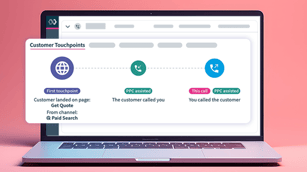
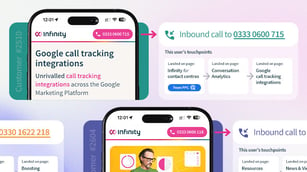
It starts with visibility. You can't fix leakage you can't see. So the first step is understanding when demand is going unanswered, and which campaigns, time periods, or customer journeys are most affected. Call tracking connects every inbound call to the marketing activity that generated it. It shows which campaigns are driving calls, when demand peaks, and where missed or abandoned volume is highest.
From there, the recovery itself needs to happen fast, because intent doesn't hang around. This is where Smart Voice, Infinity's Voice AI, comes in. Rather than sending an unanswered call to voicemail (where, let's be honest, most people just hang up), Smart Voice steps in. It answers naturally, works out what the caller needs, and moves the enquiry towards the right next step. No voicemail. No waiting on a callback that might never happen.
Finally, recovery only proves its worth once it's connected back to results. Smart Match links recovered calls to CRM and revenue data. That means marketers can see whether a call turned into a customer, and what it was worth.
What does good revenue recovery look like in practice?
A workable process usually runs in a loop, not a straight line:
- Capture every call and connect it to the campaign or channel that generated it.
- Signal: use missed-call reporting to spot where demand is going unanswered.
- Prioritise recovery effort around the campaigns and time periods where the most valuable demand is most at risk.
- Activate recovery, whether that's a live team catching up on follow-ups or Smart Voice engaging callers automatically.
Each cycle through the loop generates better data on where leakage is happening, which sharpens the next round of prioritisation.
Recovering revenue you've already paid for
So, what is revenue recovery, in one line? It's not about squeezing more leads out of the same budget through better ad copy or sharper targeting. It's about not losing the leads you've already generated in the first place. For marketers under pressure to prove ROI and justify every pound of spend, that's often the quickest, most defensible win available. It doesn't require a bigger budget, just a better safety net for the demand you're already creating.