Contents
Every marketing team has a version of this problem, even if it's not showing up anywhere on a dashboard. Demand comes in, and some of it just vanishes. A call rings out. An enquiry lands at 9 pm on a Sunday. A high-intent buyer waits on hold for four minutes and gives up. None of that gets logged as a failed campaign. It just quietly stops existing. That's exactly why knowing how to recover lost revenue matters so much.
The good news is that this is one of the more fixable problems in marketing. That's mainly because the demand was already there. You don't need a bigger budget or a cleverer campaign. You need a process for catching what's already coming through the door. Here's how to recover lost revenue from missed calls and leads, step by step.
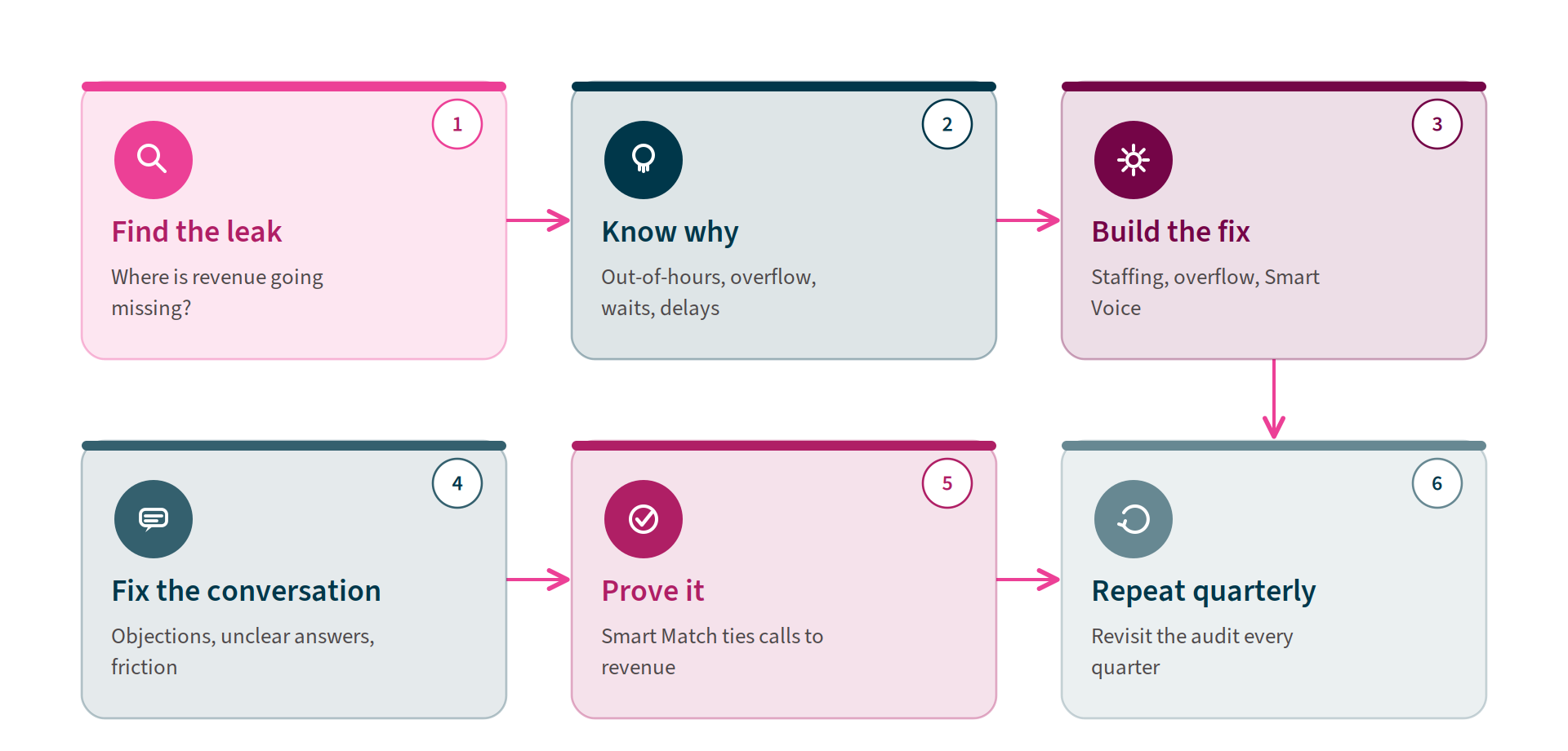
Step 1: Work out where you're losing revenue
You can't recover what you can't see, so the starting point is always visibility. Call tracking connects every inbound call to the campaign, channel, or keyword that generated it. That means you can start answering some genuinely useful questions:
- Which campaigns are generating calls that go unanswered?
- What time of day, or day of the week, does most of your missed-call volume cluster around?
- Are certain landing pages or keywords producing calls your team consistently struggles to pick up?
This usually surprises most teams: leakage is rarely evenly spread. It tends to cluster around a handful of predictable moments, which makes it much easier to prioritise.
Step 2: Understand the specific reasons demand is slipping through
Revenue leakage usually comes down to one of four everyday scenarios.
Out-of-hours enquiries. Someone gets in touch when your team has logged off for the day, and there's nobody there to answer.
Overflow and peak periods. A campaign performs well (which is the whole point), but demand outpaces your team's capacity to respond to it in real time.
Long waits and abandonment. A caller holds for longer than they're willing to, and hangs up before reaching anyone.
Delayed follow-up. The call does get logged, but by the time someone gets back to the prospect, their interest, and often their patience, has cooled off considerably.
Each of these needs a slightly different response. That's why lumping them all together as "missed calls" and hoping a callback list will sort it out doesn't work well in practice.
Step 3: Put a recovery mechanism in place for the calls you can't answer in time
For live teams, this might mean adjusting staffing around your busiest hours, or building a proper overflow process for peak periods. But there's a limit to how far that gets you. Teams can't realistically staff every out-of-hours enquiry or absorb every unpredictable spike.
This is exactly the gap Smart Voice closes automatically. Most missed calls default to voicemail, where the vast majority of callers simply hang up without leaving a message. Smart Voice steps in instead, working out why the caller is getting in touch, gathering the relevant details, and moving the enquiry towards the right next step. No voicemail. No waiting for a callback that might arrive too late to matter.
It's worth being clear that this isn't about replacing your team. It's about covering the moments your team genuinely can't be everywhere at once. Think nights, weekends, and the busiest ten minutes after a campaign goes live.
Step 4: Don't stop at the calls that get answered
Not every lost opportunity disappears before a conversation starts. Some enquiries get answered perfectly well, and still don't convert. That's often down to a pricing objection, an unclear answer, or friction somewhere in the process that nudges the prospect towards "I'll think about it."
Recovering the call is only half the job if the conversation itself is where things are quietly going wrong. Understanding what your calls are actually revealing, including the objections that come up repeatedly and the questions that trip people up, is a separate but related problem. It's one worth tackling once the missed-call side is under control.
Step 5: Prove what recovery is actually worth
None of this means much without evidence that it's working. Smart Match connects recovered calls to CRM and revenue data. That means you can see what actually happened once someone picked up, and whether it turned into a customer worth having.
This step matters more than it might seem. Phone-led enquiries frequently never make it into campaign reporting at all. That means marketing's real contribution often gets underreported. Connecting recovered calls back to revenue is how you start closing that gap and proving the value of the work.
A quick self-check before you start
Before building out a full recovery process, it's worth spending ten minutes on a rough audit. Pull up your last month of call data. If you don't have call tracking in place yet, this is reason enough to get it. Then ask:
- What percentage of inbound calls actually got answered?
- Is missed-call volume concentrated around specific times, days, or campaigns?
- Which of your campaigns generate calls at all, versus form fills or web enquiries only
- Roughly how much would it cost to replace that missed demand with fresh media spend?
That last question tends to be the one that gets budget released for a proper fix. It's much easier to make the case for revenue recovery when you can point to a specific number rather than a general sense that "we probably miss a few calls."
Step 6: Treat it as an ongoing process, not a one-off fix
Steps one through five aren't a project you finish once and move on from. Call patterns shift with the seasons, with new campaigns, and with changes to your team's hours or headcount. That's why the audit in step one is worth revisiting every quarter, rather than doing it once and filing it away.
Each time you go through it, you'll get sharper at spotting where leakage clusters, and faster at putting the right fix in front of it. That might mean a staffing tweak or a change to your overflow process. Or it might mean leaning more on Smart Voice for the gaps a live team simply can't cover.
The upshot
Recovering lost revenue from missed calls and leads doesn't require generating more demand. It requires not losing the demand you've already paid for. For most marketing teams, that turns out to be one of the fastest wins available. No extra media spend, no new campaign – just a proper safety net under the budget you're already committing.

Ready to unlock real audience insight at scale?
Discover how our call intelligence will help you
Book a demo
Related posts
Categories: All Digital Marketing Interviews Marketing News PPC