Contents
When marketers talk about Google Ads, most of the focus tends to go toward clicks and online form fills. But that’s only half the story. If your strategy ignores phone calls, you're likely missing your most valuable leads, and call tracking for Google Ads is how you close that gap.
Calls are often 10x more likely to convert than inbound web leads. They’re higher intent, more urgent, and typically further along the decision-making journey. That makes Google Ads call tracking a critical part of understanding true campaign performance.
If you want to improve your performance on Google Ads, you need visibility into what happens after someone picks up the phone. Without tracking phone calls from Google Ads, you're optimising campaigns with incomplete data.
So, call tracking systems are no longer a “nice to have” if you’re a marketer in a call-centric business – it’s an essential tool that’ll help you improve your paid ads strategy and unlock better ROAS, CPL, and lead quality.
What is call tracking in Google Ads?
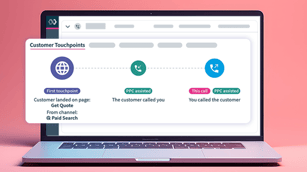
Call tracking in Google Ads is the process of tracking phone calls generated from your ads and attributing them back to specific campaigns, keywords, and user journeys. Using call tracking for Google Ads, marketers can measure offline conversions, improve attribution, and feed better conversion signals into Smart Bidding strategies.
Google Ads call tracking vs. call tracking software
Google does offer native call tracking but it has its limits. While Google Ads call tracking is a useful starting point, it only provides surface-level data.
If you’re handling low volumes of calls, Google’s solution might be enough. But once you scale, the cracks start to show:
- You can’t see why someone called (sales or support?)
- There’s no visibility into the outcome of the call
- It doesn’t provide insight into intent, tone, or lead quality
On the flipside, call tracking software gives you full visibility:
- Understand which campaigns drive high-value calls
- Distinguish between qualified leads vs. non-sales calls
- Feed call intent and outcome data into Google Ads for smarter bidding and better optimisation
As privacy changes limit visibility across the rest of the customer journey, the difference between the two tools will only be more and more noticeable.
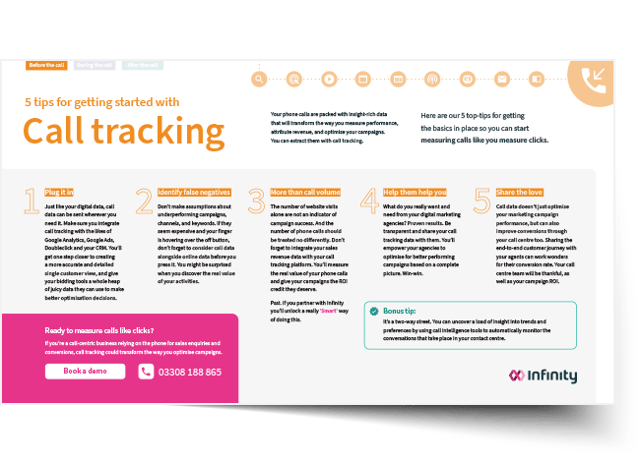
5 tips for getting started with call tracking
Get your cheat sheet
Why use call tracking for Google Ads
The marketing world is shifting. As we move into a “cookie less” future, marketers will need to rely more heavily on first-party data, and call tracking for Google Ads plays a critical role in capturing it. Calls are packed with insight: intent, objections, decision drivers, and conversion outcomes. This makes them one of the most valuable conversion signals available to marketers.
When you track and analyse those calls, you can:
- Identify the keywords and campaigns driving valuable conversations
- Feed real-time offline conversion tracking data into Google’s Smart Bidding algorithm
- Reduce wasted spend on keywords that drive support or spam calls
With Infinity’s Smart Outcomes feature, you can take this a step further. It automatically categorises calls by intent and outcome, allowing you to optimise campaigns based on lead quality - not just volume.
How call tracking improves Google Ads performance
Using call tracking with Google Ads, you’re not just tracking conversions , you’re improving them. By feeding high-quality signals into Smart Bidding, you can:
- Increase lead quality
- Reduce cost per lead (CPL)
- Improve return on ad spend (ROAS)
- Optimise campaigns based on real outcomes, not assumptions
How to set up call tracking for Google Ads: A practical guide
Ready to get started? Here’s how to make it happen:
-
Integrate Infinity with Google Ads
Use Infinity’s Google Ads Integration to connect platforms and track call conversions automatically.
-
Implement Dynamic Number Insertion (DNI)
Display unique phone numbers based on the source or campaign using DNI. Learn more in this complete guide.
-
Use Value Track Parameters
Tag campaigns with custom parameters to pass granular data about the click source. Here’s how to implement tagging.
-
Configure Smart Outcomes
Define outcomes like sales-qualified leads, bookings, or policy renewals. Infinity will automatically score and feed these into Google Ads.
-
Refine based on insights
Use Infinity’s reporting suite to optimise targeting, bids, and messaging in real-time.
You can find additional setup support in the Google Ads FAQs and this Campaign Manager configuration guide.
Key benefits of Google Ads and call tracking combined
When you use call tracking for Google Ads effectively, you unlock:
- Higher-quality leads: Focus budget on campaigns driving actual conversions.
- Lower cost-per-click (CPC): Improve Quality Score with better targeting.
- Higher ROAS: Optimise based on high-intent conversions .
- Smarter decision-making: Use real-time call data and conversion signals to guide strategy.
Plus, with Google’s Smart Bidding and new AI Max features, the ability to feed call outcome data into campaigns will give you even more of an edge. You’re no longer limited to surface-level conversions — you're optimising for actual business results.
Learn more about Smart Bidding with AI
Why high-intent calls don’t always convert (and how to fix it)
Driving high-intent calls using call tracking in Google Ads is only half the job. The real challenge is turning those calls into revenue. In many cases, valuable leads are being lost, not because of your campaigns, but because of what happens during the call itself. Common conversion barriers include:
- Availability issues (e.g. product out of stock or no appointment slots)
- Poor call handling or missed objections
- Mismatched messaging between ads and the conversation
- Incorrect targeting driving the wrong type of enquiries
- Detect lost conversions from high-intent calls
- Pinpoint the exact barrier preventing conversion (e.g. trust, price, availability)
- Prioritise which issues to fix first based on impact
Without visibility into these issues, you’re left optimising campaigns based on incomplete data often increasing spend without improving outcomes
This is where Infinity’s Conversion Barriers comes in. It works alongside Google Ads call tracking and Smart Outcomes to not only identify high-intent calls, but explain why they didn’t convert. Using AI-powered analysis, it helps you:
- Detect lost conversions from high-intent calls
- Pinpoint the exact barrier preventing conversion (e.g. trust, price, availability)
- Prioritise which issues to fix first based on impact
Take action across marketing, sales, or operations to improve performance The result? You’re no longer just driving more calls, you’re removing the friction that stops them from converting. That means better conversion rates, lower CPL, and stronger ROAS from your Google Ads campaigns.
Unlock smarter Google Ads with call tracking
If you're serious about improving your Google Ads performance, it might be time to get call tracking on-side. As consumer journeys grow more complex and less trackable via cookies, first-party call data is your competitive advantage. Call tracking software helps you get your hands on this rich data and automatically feeds it back to your bidding platforms. Result?
Track, analyse, and optimise every call so you never miss a high-intent lead again.

Ready to unlock real audience insight at scale?
Discover how our call intelligence will help you
Book a demo
Related posts
Categories: All Digital Marketing Interviews Marketing News PPC