Contents
With marketing budgets being increasingly squeezed, around 44% of marketers consider better measurement of Return on Investment (ROI) one of their top priorities. And yet for some reason, only 35% of marketers consider tracking ROI ‘very’ or ‘extremely’ important. That’s a huge problem when proving marketing ROI is now critical for securing budget, improving campaign performance, and driving sustainable revenue growth.
In this blog, we’re going to delve into what marketing ROI is, how to measure marketing ROI accurately, and why it’s become one of the most important marketing performance metrics for modern businesses. We’ll also explore how marketers can use marketing attribution, first-party data, and AI-powered optimisation tools to improve marketing ROI and eliminate wasted spend.

Reduce waste, improve ROI, and drive growth
What is marketing ROI?
Marketing ROI is a business metric that measures the amount of profit, or loss, your business generates through marketing activities. Tracking marketing ROI metrics helps marketers understand which campaigns, channels, and activities are generating real commercial impact - not just clicks or impressions.
Setting revenue goals against your marketing activities is a super important aspect of measuring your marketing ROI. Without clear revenue attribution, it becomes difficult to understand which marketing activities are genuinely driving pipeline and revenue growth. For instance, if you spend £1 on digital advertising, how much profit do you expect that £1 of marketing spend to generate?
A high ROI means your campaigns are making more money than you spend on them and, delivering efficient customer acquisition. That's exactly what you want. Nobody likes wasted budget, especially when purse strings are getting tighter.
Calculating your marketing ROI enables you to see which activities have the most impact. This makes budget optimisation significantly easier, helping marketers focus spend on the channels, campaigns, and keywords driving the highest-quality leads and strongest return on ad spend (ROAS).
As a result, you can plough more resource into the stuff that’s generating that all-important revenue, and take marketing spend away from poor performance activities.

Ultimate guide to paid media optimisation
What is a good marketing ROI?
If you’re new to measuring ROI, you might be wondering what the average marketing ROI looks like. Of course, the average marketing ROI differs depending on industry, but a good rule of thumb for marketing ROI is to aim for a ratio of 5:1. An exceptional marketing ROI usually has a ratio of 10:1, but this isn’t a hard and fast rule.
All in all, you want to be able to demonstrate to stakeholders within the business that every penny you spend is adding value. When that’s the case, it becomes easier to justify further investment into tried and tested marketing activities that drive growth.
Common marketing ROI metrics marketers should track
While overall return on investment is important, marketers should also monitor the supporting metrics that influence marketing ROI performance.
Some of the most important marketing ROI metrics include:
- Return on ad spend (ROAS)
- Cost per lead (CPL)
- Customer acquisition cost (CAC)
- Conversion rate
- Customer lifetime value (CLV)
- Lead-to-sale conversion rate
- Pipeline contribution
- Revenue attribution by channel
Together, these metrics provide a much clearer picture of campaign performance and help marketers make smarter, more commercially focused decisions.
How do you calculate marketing ROI?
Simply put, ROI compares the profits that resulted from your campaign to how much the overall campaign cost. A basic calculation for measuring marketing ROI is.
ROI = (Net profit of your digital marketing campaign/
Total cost of your digital marketing campaign) x 100
Of course, this calculation depends on accurate revenue attribution. This is where marketing attribution becomes essential. Without accurate attribution across both online and offline touchpoints, marketers risk underreporting ROI and undervaluing high-performing channels.
To do this, you need full visibility of the revenue data associated with all marketing activities. That includes offline conversions like phone calls, which are often some of the highest-intent and highest-value interactions in the customer journey.
Why is measuring marketing ROI important?
The most important question is, why measure marketing ROI? Because if you can’t clearly connect spend to revenue, it becomes incredibly difficult to optimise performance or justify future investment.
ROI measures the amount of profit or loss, your business generates through your marketing activities. The ideal marketing ROI scenario is when the profit you make exceeds what you invested in your marketing activities. In other words, it’s money well spent that’s ultimately enabled you to generate revenue.
To hit your revenue targets in the most efficient way possible, you need to invest in activities that are generating the most profit and identify which ones are just burning up budget. An underperforming marketing campaign isn’t commercially viable, as your operational costs are likely to impact your ability to break even yet alone turn a profit. Measuring marketing ROI helps you figure out what drives the most sales at a granular level. This includes understanding which campaigns generate high-intent leads, which channels deliver the best conversion rates, and where revenue leakage is impacting performance.
Smart Outcomes product guide
for marketers
This enables you to make data-driven marketing decisions about where you should and shouldn’t be focusing spend, and you can prevent under- or over-valuing specific activities in future campaigns. So, if your PPC campaigns aren’t delivering any leads but social is consistently generating sales, you can re-allocate PPC budget to drive even more activity through social.
It’s important to note that monitoring your marketing ROI needs to be a rigorous and ongoing process. Customer behaviour, campaign performance, and attribution models are constantly evolving, especially as AI-driven advertising and privacy changes reshape digital marketing.
As mentioned above, once you’re able to clearly demonstrate your marketing ROI to key stakeholders within the business, it’ll likely make it a whole lot easier to secure ongoing/ future marketing investment.
What tools do you need to measure marketing performance?
If your key focus is to improve your marketing ROI and start delivering maximum profits with minimum investment, you’ll need full visibility of the buyer journey from start to finish. But without the right tools in place, this is a huge challenge.
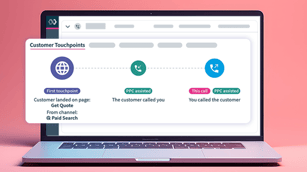
The customer journey is evolving every day and it’s becoming more complex. An increasing number of touchpoints means customers will interact with your products and/ or services on lots of different online and offline channels. It’s easy to connect revenue to digital marketing activities when purchase journeys take place online only. But, when customers pick up the phone and convert offline, joining up the dots can be tricky, and you can easily lose visibility of your true ROI.
If you want to accurately track profit and understand ROI, you need to be able to close the gap between online research and offline conversions.

Customer journey analytics: Why performance is plateauing
Learn how to stop revenue leakageWhy marketers struggle to prove ROI
One of the biggest challenges marketers face is attribution blind spots.
Modern customer journeys rarely happen in a straight line. Buyers move between channels, devices, and conversations before converting, which makesaccurate marketing attribution increasingly difficult.
Phone calls are one of the biggest missing pieces of the puzzle. While many analytics platforms track online clicks and form fills effectively, they often fail to connect offline conversations to revenue outcomes.
The result?
- Underreported marketing ROI
- Wasted budget
- Poor optimisation decisions
- Low visibility into lead quality
- Difficulty proving commercial impact
This is why first-party conversation data is becoming such a valuable asset for marketers focused on improving efficiency and proving performance.
What tools do you need to measure marketing performance?
If your key focus is to improve your marketing ROI and start delivering maximum profits with minimum investment, you’ll need full visibility of the buyer journey from start to finish. That means understanding how every touchpoint, from PPC and paid social through to phone calls and offline conversions, contributes to revenue.
The customer journey is evolving every day and it’s becoming more complex. Today’s buyers move across multiple channels before converting, making multi-touch attribution and accurate marketing measurement more important than ever.
But, when customers pick up the phone and convert offline, joining up the dots can be tricky, creating attribution blind spots that can seriously distort marketing ROI reporting.
If you want to accurately track profit and understand ROI, you need to be able to close the gap between online research and offline conversions. This is where call tracking and conversation intelligence become invaluable for marketers trying to prove true campaign impact.
.png?width=640&name=5-Ways-Marketers-Cheat-Sheet-Thumbnail%20(1).png)
Five practical ways to turn first-party call insights into stronger campaigns
How AI is changing marketing measurement
AI is transforming the way marketers measure and improve ROI.
Instead of relying on surface-level conversion data, marketers can now use AI-powered tools to understand intent, outcomes, and conversion barriers at scale.
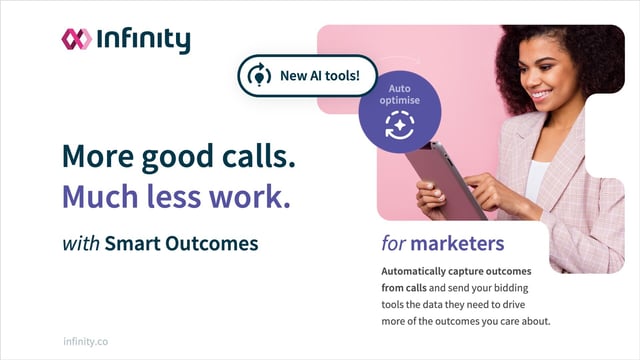
Solutions like Infinity Smart Outcomes automatically categorise calls based on intent and outcome, helping marketers understand which campaigns are driving genuine sales opportunities, not just enquiries.
This richer first-party data can then be shared directly with advertising platforms to improve optimisation, reduce wasted spend, and increase ROAS.
In short, AI is helping marketers move from simply reporting performance to actively improving it.
Joining up the customer journey with Call Tracking
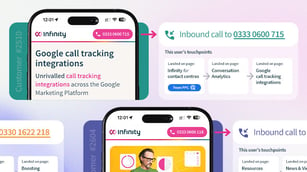
Infinity’s Call Tracking with Smart Match clears up your marketing blind spots and gives you the inside scoop on which campaigns, channels, and keywords are generating the most revenue via offline call conversions. Being able to pinpoint the specific marketing activities that resulted in a transaction, either online or offline, is a sure-fire way of accurately calculating your marketing ROI.
Plus, Infinity’s speech analytics suite, Conversation Analytics, takes your budget optimisation one step further by answering the questions you’ve never been able to ask: what is it about our product or service that has our customers on the fence? How are we converting leads? How can we turn that make-or-break moment into a win?
Conversation Analytics provides intel on common sticking points that delay conversions, and impact the profitability of campaigns. You can pinpoint the moment when sentiment dips and work with sales to create scripts that turn an unhappy caller into a loyal advocate. You can even highlight the language or the incentives that resonate most with customers and use that knowledge to perfect your call handling - and maybe even upsell.
Want to truly understand the ROI your marketing activities generate? It’s time to bridge the online to offline gap with call tracking.
Try our free ROI calculator now
Start a conversation with us today to find out how simple the process is.

Ready to unlock real audience insight at scale?
Discover how our call intelligence will help you
Book a demo
Related posts
Categories: All Digital Marketing Interviews Marketing News PPC