Contents
Here’s the uncomfortable truth: your biggest PPC blind spot isn’t in the click-through rate or your bidding strategy. It’s in the part of the customer journey you can’t see; the moment someone picks up the phone. And while marketers are being asked to deliver more with less, that hidden moment is quietly draining budget, shrinking ROAS, and burying your best results.
The kicker? Phone calls are often the strongest indicator of buying intent, but the insight inside them rarely makes it back into your optimisation strategy. So, while your dashboards will often tell one story, your customers are telling a very different one over the phone.
Let’s explore why PPC conversions aren’t what they seem and, more importantly, how to fix them.
Building the AI feedback loop for PPC
Why PPC clicks must convert, especially now
PPC remains one of the most dependable channels for lead generation. But conversions are harder to achieve when you’re optimising in the dark or without the right data. Many marketers assume they have a conversion-rate problem when, in reality, they’re dealing with an incomplete-data problem.
If you don’t know what happens after someone clicks, and especially after they call, then your view of performance is skewed from the start. That’s when wasted spend creeps in, smart bidding becomes less effective, and campaigns that look healthy on the surface quietly underperform.
Power up your PPC with AI
A data-driven formula for maximum ROAS
The main reasons PPC clicks don’t convert
1. High-volume keywords fuel low-quality traffic
High-volume keywords look tempting. They deliver traffic, they produce activity, and they keep dashboards busy. But they often attract people who are nowhere near ready to convert. If the keyword itself is the issue, no amount of tweaking ad copy or adjusting targeting will fix the root problem. Without real proof of which keywords drive high-intent calls – and which generate noise – your campaigns are optimising based on assumptions, not truth.
2. Sales and marketing misalignment hides the real story
This is one of the biggest hidden blockers to improving PPC conversions. Without visibility of what happens on calls, the relationship between marketing and sales relies heavily on opinions, not facts. Marketing believes they’re sending qualified leads. Sales don’t always agree. And neither team can see the full journey that led to the call or the conversation that followed it. When those gaps exist, high-intent leads slip through the cracks before anyone notices.
3. Poor-quality data ruins good optimisation
Smart bidding is only as smart as the signals you feed it. If Google Ads or Performance Max only receive basic conversions like page visits, form submissions, or “a call happened”, the platform can’t differentiate between someone with genuine buying intent and someone calling for a refund, an address, or opening hours. Weak data leads to weak targeting. And weak targeting leads to wasted budget.
Optimise paid performance without lifting a finger
Building the AI feedback loop for PPC
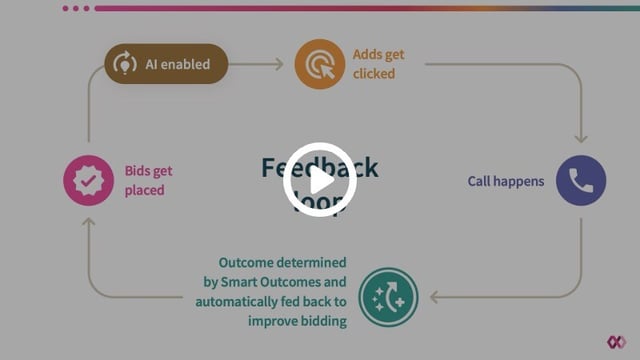
Feedback Loop Webinar
4. Ad copy doesn’t reflect the customer’s real language
You can test headlines all day long, but if you’re not speaking in the language your customers naturally use, you’ll always be slightly off the mark. Phone calls reveal something that analytics platforms can’t: the phrasing, frustrations, and priorities buyers share in their own words. When you understand how people talk about their needs, you can build ads and landing pages that resonate instantly.
5. Phone call black holes hide your real results
This is the biggest PPC blind spot of them all. When someone calls, visibility usually vanishes. You can’t see which campaign or keyword drove the call, what happened during the conversation, or whether it resulted in revenue. And because many high-consideration purchases involve a phone call, the missing insight creates a huge disconnect between what’s being tracked and what’s actually converting. The result is simple: your results look worse than they are, and your optimisation is based on half the truth.
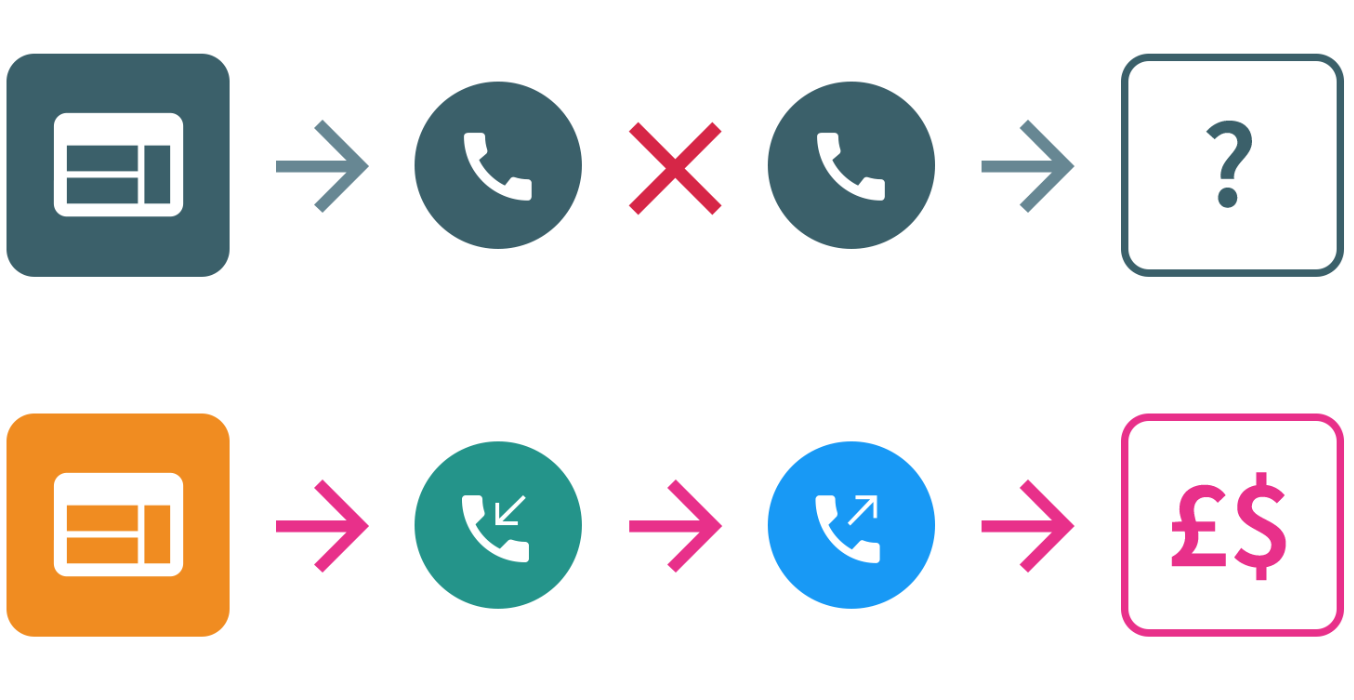
How to fix low PPC conversion rates properly
1. Use call tracking to uncover keyword-level performance
Call tracking gives you the clarity you need to stop wasting budget. Instead of relying on click data alone, you can see which keywords consistently generate engaged, high-intent callers and which attract time-wasters. Once you understand the difference, optimisation becomes far more efficient. Marketers who make this shift often see immediate drops in CPL and fast improvements in ROAS because they’re finally backing the keywords that genuinely drive revenue.
2. Improve alignment by giving teams the same view of the call journey
When you can see the online steps someone took before they called, what they asked about, and whether the conversation moved forward, the gap between marketing and sales disappears. Teams no longer debate lead quality; they work from a shared understanding. This context strengthens follow-up, sharpens targeting, and removes the operational friction that slows down conversions.
.png?width=640&name=5-Ways-Marketers-Cheat-Sheet-Thumbnail%20(1).png)
Five practical ways to turn first-party call insights into stronger campaigns
3. Upgrade your bidding strategy with first-party call outcomes
This is the game-changer. When platforms like Google Ads receive actual call outcomes – not just “a call occurred” – they learn which interactions signal real commercial value. Infinity’s Smart Outcomes uses AI to detect intent and outcomes from every call, then feeds that data straight into your bidding tools. That means your campaigns begin to optimise toward real revenue indicators such as “intent to buy”, “booking made”, or “purchase completed”. And because the data flows in automatically, performance improvements often happen fast, typically within the first month.
4. Strengthen your messaging with real customer insight
Call intelligence gives you a constant feed of unfiltered customer language. You’ll hear the objections that block conversions, the triggers that spark interest, and the moments where confusion creeps in. This helps marketers refine ad copy, reposition offers, tighten landing pages, and build more effective journeys. When your messaging is shaped by real customer conversations, conversion rates rise – often significantly.
Smart Outcomes product guide
for marketers
5. Close the phone-channel blind spot and complete the full-funnel picture
When every call is tracked, categorised, and linked to its source, the invisibility disappears. You can finally see where your best leads come from, which campaigns produce your most valuable customers, and where wasted spend hides. This level of insight helps you cut budget drains, scale high performers, and optimise with confidence. The picture stops being blurry, and your results stop being unpredictable.
Why first-party call data is the secret to unlocking PPC performance
This is where Infinity’s Smart Outcomes brings everything together. It captures call intent and outcomes automatically, ties them back to campaigns and keywords, and sends those signals straight into your bidding tools. That creates a real-time optimisation loop that helps marketers reduce CPL, boost ROAS, and finally understand what’s actually driving results.
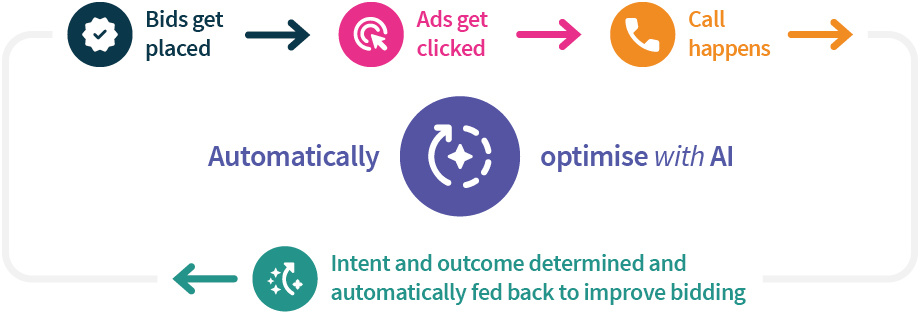
Because you’re dealing with rich, first-party data that’s deeply tied to customer behaviour, it lifts performance across the entire journey. Messaging becomes sharper. Bidding becomes smarter. Targeting becomes cleaner. And marketers finally get credit for the impact they’re delivering, including the conversions that used to disappear into the phone call black hole.
Start your journey to better-paid media performance
If you’re fighting against flat PPC conversions, unpredictable lead quality, and murky optimisation signals, it’s not because your campaigns are broken; it’s because your visibility is. Once you unlock the insight hidden inside the calls you make and receive, your ability to optimise transforms almost overnight.
With first-party call data and AI-powered outcome tracking, you can finally eliminate your PPC blind spot, build stronger campaigns, and drive more revenue from the impressions and clicks you already pay for.
If you’re ready to see how Smart Outcomes will give your paid media the clarity it’s been missing, now’s the moment to take the next step and start making smarter, more confident decisions.

Ready to unlock real audience insight at scale?
Discover how our call intelligence will help you
Book a demo
Related posts
Categories: All Digital Marketing Interviews Marketing News PPC
29 Jan 2026 in News PPC Marketing Digital Marketing
Smart Outcomes: Sector specific signals for PPC optimisation
Read more

1 Jan 2026 in PPC Marketing Digital Marketing
Get more value from your marketing data in the New Year
Read more

26 Mar 2025 in PPC Digital Marketing
Smart bidding for marketers: Why AI-powered data is your edge
Read more