Find the integration
that fits your stack
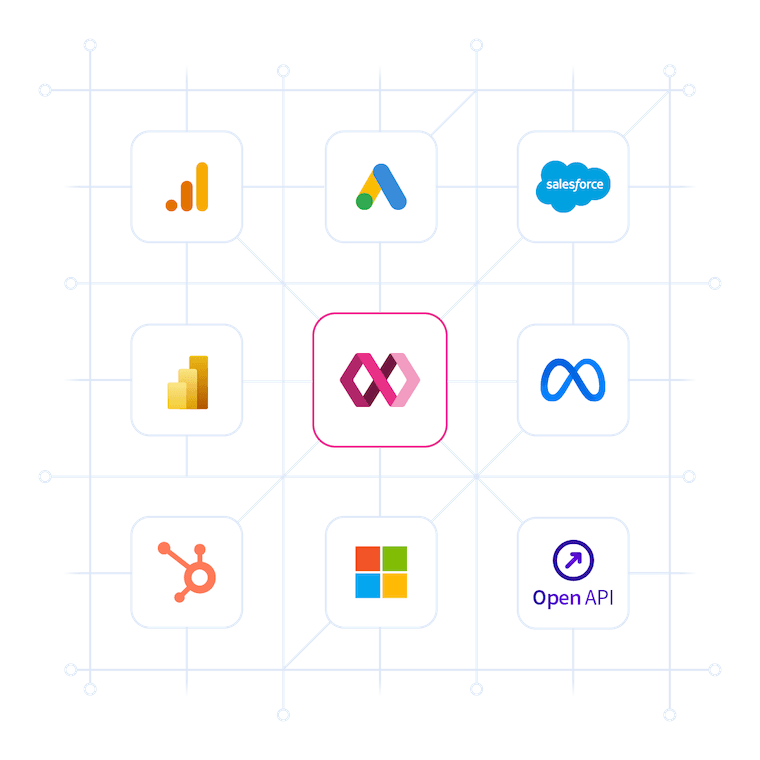
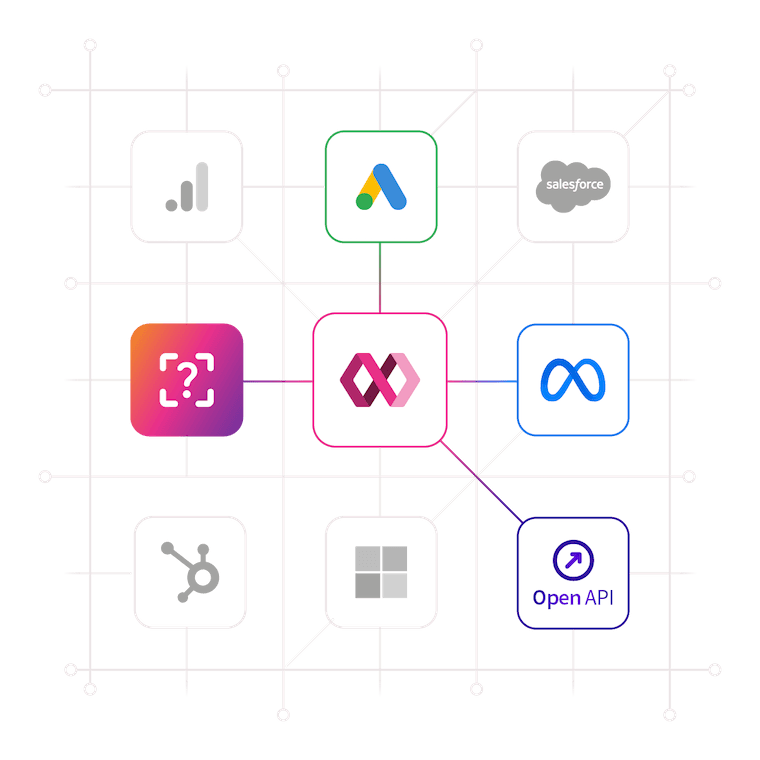
45+ native integrations across advertising, analytics, CRM, business intelligence and testing platforms, plus an open API for everything else.

Send call outcomes and revenue into bidding and campaign optimization.
Send goals, phone calls, call type and transaction value into GA4 in real time.
Push calls into Salesforce and show key caller information to agents in real time through a screenpop.
Connect call conversions and revenue to Facebook campaigns through the Conversions API.
Report paid search calls down to keyword level inside your bid management platform.
Push phone calls into HubSpot and surface them on the contact timeline.
Bring call outcomes into Microsoft Power BI reporting.
Understand the offline conversions driven by your LinkedIn Ads activity
Pass calls, call ratings and CRM events into Microsoft Advertising as conversions.
Identify whether display impressions contributed to phone calls.
See the phone demand your Instagram activity generates.
Link offline events such as phone calls to online events using Adobe Data Sources.
Send goals and phone call data into Webtrends in real time.
Match calls and call outcomes to clicks from your affiliate sites.
Include Infinity call data in Innovid reports.
See how site changes affect phone calls, not just online conversions.
Deploy Infinity in minutes through Tag Manager.
Use Infinity tracking numbers alongside your experiments and personalization projects.
Measure the impact of your experiments on call volume and outcomes.
Link phone calls back to the Partnerize campaigns that drove them.
Measure the impact of your experiments on call volume and outcomes.
Send Infinity data into Acquisio reporting.
Link phone calls back to the Criteo activity that drove them.
Link phone calls back to the Teads campaigns behind them.
Push call and visitor data into the Webgains network.
Push the visitor and call events you choose into Quantcast.
Get Infinity data into your Looker suite and build your own charts and reports.
Build the data flow your business needs.
Insight has no value
until it changes what happens next
Every call carries information your platforms cannot see. Which customers had genuine intent. What they asked about. Whether the conversation created value, and how much.
While those signals sit in a dashboard, the same five things keep happening:
Advertising platforms carry on optimizing towards incomplete conversion data.
CRM workflows cannot respond to what the customer actually said.
Reporting understates the revenue generated over the phone.
Sales teams pick up without the context behind the inquiry.
Marketing decisions stay one step removed from commercial outcomes.
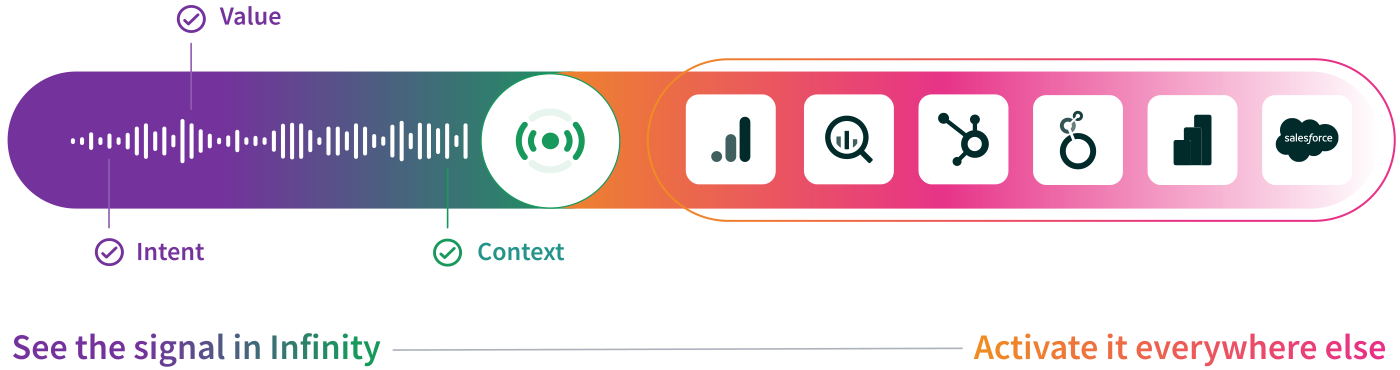
Infinity moves those signals into the platforms and workflows that can act on them.
Two kinds of integration,
and the difference matters
Reporting integrations help you see more. Activation integrations change what your platforms and teams actually do. A connection that only improves a dashboard leaves the decision exactly where it was.
The strongest integrations do both.

The Infinity loop
Turn every customer signal into action
Infinity brings call and conversation data into a continuous optimization cycle. Integrations are how that cycle reaches the rest of your stack
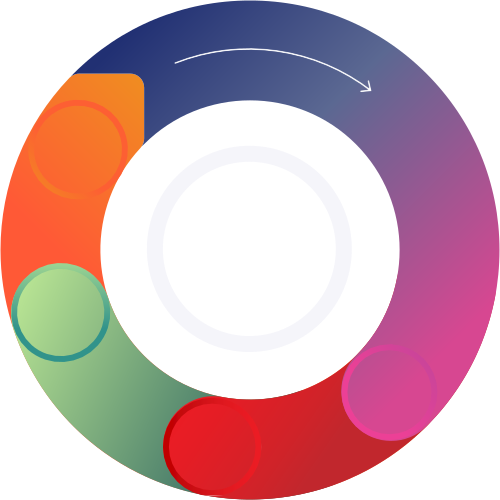
Connect every call to the campaign, channel, keyword and journey that generated it.
Identify intent, conversation outcomes, customer needs and commercial value.
Understand which campaigns, audiences, opportunities and customer issues matter most.
Conversion Barriers, Reporting and expert insight
Send the right signals into advertising platforms, CRMs, analytics tools and workflows.
Integrations and the open API
What is the Infinity loop?
Marketing is a continuous cycle of measuring, learning, and improving.
But most optimization decisions are made using incomplete signals, because customer conversations never make it into the process.
Infinity closes that gap by transforming first-party conversation data into AI-driven signals that reveal what's happening, what's blocking conversion, and where to act next.
Every signal makes your loop smarter – helping you improve performance, reduce waste, and grow revenue faster.
Every activation creates a new result. That result becomes a stronger signal for the next decision.
Better bidding, faster follow-up, complete reporting, higher-quality demand, more revenue.
Advertising integrations
Give your ad platforms better signals to optimize with
Advertising algorithms can only learn from the conversions they can see.
When valuable phone inquiries and the sales behind them stay invisible, platforms optimize around clicks and form fills rather than the outcomes that made money. Infinity sends call intent, conversation outcomes and revenue values into the platforms making those decisions.
What marketers activate:
Record valuable calls as conversion events, rather than every call.
Send lead-quality and outcome data into bidding.
Pass revenue values into campaign optimization.
Build lookalike audiences from customers who called and bought.
Pull budget back from the sources producing poor-quality inquiries.
Scale the campaigns behind high-intent conversations and revenue.
Stop teaching algorithms what generated a lead. Start teaching them what generated value.
Ultimate guide to paid media optimization
Download Infinity’s ultimate guide to paid media optimization for insights on scaling smarter with outcome-based strategies to boost ROAS and cut CPL.
Get your guide
CRM and marketing
automation integrations
Keep marketing visible after the lead reaches Sales
For most teams, marketing visibility ends at the CRM. An inquiry arrives, ownership changes, and the campaign that created it stops being part of the story.
Infinity connects call source, journey, outcome and revenue data to contact, lead and opportunity records, so the line from first interaction to closed sale stays intact.
What marketers activate:
Add call and acquisition context to CRM records.
Connect campaigns to pipeline and revenue.
Trigger follow-up workflows from call activity.
Segment contacts by intent or conversation outcome.
Alert the right team the moment a valuable inquiry lands.
Feed sales outcomes back into media optimization.
Connect the campaign to the call, the call to the customer and the customer to revenue.
Analytics and BI integrations
Give your reporting the full conversion picture
Analytics cannot give you an accurate view of performance while your most valuable conversions happen on the phone and never reach the data.
Infinity connects call, outcome and revenue data to analytics and BI tools, so online and offline performance report together.

What marketers activate:
Send call events, call type and transaction value into GA4 in real time.
Combine digital and phone journeys in the same dashboard.
Build custom attribution and performance models.
Analyze call outcomes next to campaign, customer and sales data.
Give Marketing, Sales and Finance one version of performance.
Digital activity plus call outcomes is a more complete view of ROI.
Workflow and customer experience integrations
Put customer context into the hands of the teams who need it
Activation is not only about algorithms. The person answering the phone does a better job when they already know what brought the customer there.
Infinity can show caller information to agents in real time through a screenpop, so the campaign, keyword and journey behind a call are visible before anyone says hello.
What teams activate:
Show campaign and keyword context before the call is answered.
Log call activity automatically against the customer record.
Connect outcomes back to the originating marketing journey.
Improve routing, follow-up and sales conversations.
Better context before "hello". Better outcomes after it.
Open API
Your data should never reach a dead end
Every business runs different systems and needs to activate its data in its own way.
Infinity’s open REST API gives technical teams secure access to call, conversation, outcome and revenue data, so you can connect Infinity to proprietary tools, custom workflows and advanced reporting environments.
What teams build with it:
Custom connectors to internal systems.
Data flows into warehouses and data lakes.
Bespoke dashboards and custom attribution models.
Internal workflow and automation triggers.
Inputs for predictive analytics.
Connections to proprietary CRM and customer platforms.
Fast to connect. Built for marketers.
Go from connected to activated – fast
Integrations should not turn into another long technology project. Infinity’s native connectors are built around the platforms marketers already use and the outcomes they need to improve.
Fast setup
Core advertising integrations can typically be connected in around 15 minutes. HubSpot can be live in under 30 minutes where standard requirements apply.
Marketer-friendly
Native connectors and guided setup, rather than building a new workflow from scratch.
Flexible
Native integrations, API connections, or a combination of both.
Supported
Infinity teams help you configure data flows around your marketing goals.


Enterprise ready
ISO 27001-certified information security, Google Cloud Partner and Meta Business Partner, call tracking in 75+ countries.
Setup time depends on the platform, the data available and what you want to activate. We will tell you which of those applies to you before you start, not after.
Better-connected data drives better marketing outcomes
37%
Year-on-year revenue increase using Smart Outcomes call data to improve paid media optimization.
300%
Uplift in sales calls from PPC
connecting call revenue to campaign optimization through Smart Match.
32%
Reduction in cost per acquisition
used call and campaign data to improve acquisition efficiency.
Infinity are setting the standard when it comes to seamlessly fitting into the modern tech stack. Google Analytics 4 is crucial for futureproofing measurement for our clients.
Partner – Head of Data, Advanced Analytics & GCP Solutions, EssenceMediacom
Is a platform you rely on missing?
Tell us what you need to connect
We add new integrations regularly, and the open API covers most of what the directory does not. If the platform you depend on is not listed, it is worth a conversation.
Ready to put your call data to work?
Connect Infinity to the platforms your marketing team already uses, and turn customer conversations into signals that improve bidding, reporting, workflows and revenue.
45+ integrations
Fast native setup
Open API
Expert support
Integration FAQs
General integrations
Infinity supports 45+ native integrations across advertising and bid management, analytics, business intelligence, CRM, conversion rate optimization, affiliate and partnership marketing, and tag management, plus an open API for anything not covered.
Advertising integrations include Google Ads, Microsoft Advertising, Meta, Search Ads 360 and Campaign Manager 360. Analytics and BI integrations include GA4, Adobe Analytics, Looker and Power BI. CRM integrations include Salesforce and HubSpot.
Setup time varies by platform, and there is no single figure that applies to every Infinity integration.
Core advertising integrations with Google Ads, Microsoft Advertising and Meta can typically be connected in around 15 minutes. HubSpot can be live in under 30 minutes where standard requirements apply.
Custom attribution models, warehouse flows and bespoke API work take longer, because scope sets the timeline rather than the connector. Infinity confirms the likely effort before configuration begins.
Most native Infinity integrations are designed to be configured by marketers or marketing operations teams, using guided setup rather than custom code.
Developer support becomes useful for API work: building a custom connector, sending data to a warehouse, or connecting a proprietary platform.
Yes. Infinity sends signals to several destinations at once, because most marketing teams need the same call data in more than one place.
A single call outcome might be recorded as a conversion in Google Ads, attached to a lead record in Salesforce, and included in a GA4 report, each destination receiving only the fields relevant to it.
Infinity can share four broad types of call and conversation data: marketing source and journey, conversation intent, conversation outcomes, and revenue value.
Source and journey data covers the campaign, channel, keyword, advert and on-site behavior before the call. Intent and outcome data comes from Smart Outcomes and Conversation Analytics, and revenue data from Smart Match or a connected CRM. Which fields a platform receives depends on what it supports and how the customer configures it.
Availability depends on the Infinity package and the capabilities in use, because some integrations rely on products such as Smart Outcomes or Smart Match to generate the signal being sent. The Meta integration, for example, is included with pro and enterprise accounts.
Advertising integrations
Infinity sends call and goal actions from Infinity into Google Ads, bringing phone conversions and offline outcomes into campaign measurement and bidding.
Call Tracking identifies the campaign, advert and keyword behind each call. Relevant outcomes are then recorded as events in Google Ads, so campaigns learn from meaningful actions such as quote requests, appointments or purchases rather than treating every call as equal. Revenue can be sent through as goal value.
Call outcome signals tell an advertising platform what actually happened during a conversation, rather than only that a conversation took place.
Generic signals, such as every call or every call over a set duration, mix genuine prospects with service inquiries and low-quality leads. Outcome-level signals such as a booked appointment or a qualified opportunity give bidding systems a clearer definition of success.
Budget then moves towards the campaigns and keywords producing commercial outcomes, and away from those producing activity.
Infinity shares customer conversation events with Meta through the Meta Conversions API, creating a server-side connection between call data and Meta’s advertising systems.
Because the connection is server-side, it reduces reliance on browser-based tracking alone. Call goals recorded in Infinity become available in Meta Ads, including conversation outcomes, revenue values and keywords mentioned on the call. Lookalike audiences can then be built from the customers who called and bought, which is where paid social gains most from call data.
Yes, where revenue data is available and the destination platform supports value-based conversions.
Infinity connects calls to actual sales value through Smart Match or a connected CRM, and that value passes into campaign optimization. Two campaigns can each generate ten conversions while one produces far more revenue; passing the value in gives the platform the context to tell them apart.
Infinity creates the revenue signal. The advertising platform decides how to act on it.
CRM and marketing automation
Infinity pushes calls into Salesforce and can display key caller information to agents in real time through a screenpop, so acquisition context sits alongside leads, contacts and opportunities.
The campaign, channel and keyword behind an inquiry, the conversation outcome and, where Smart Match or CRM revenue data is in place, the value of the resulting sale can all be attached to the record. Sales outcomes recorded in Salesforce can also be fed back into media optimization.
Infinity pushes phone calls into HubSpot, where they surface on the timeline for the contact in question. Where standard requirements apply, the integration can be live in under 30 minutes.
Call data can enrich contact records with acquisition context and trigger HubSpot workflows based on call activity or conversation outcome, which makes a phone conversation a usable trigger rather than an event happening outside the system.
Yes. Call activity and conversation outcomes can be used as triggers inside connected CRM and marketing automation platforms.
Typical uses include alerting a sales owner when a high-intent call arrives, starting a follow-up sequence after an unresolved call, or suppressing a nurture program once a prospect has spoken to someone. The trigger logic lives in the CRM. Infinity supplies the signal that fires it.
Yes, and it is one of the main reasons marketing teams use a CRM integration.
Infinity attaches the originating campaign, channel and keyword to the call, and the CRM records what happened next: whether the enquiry became an opportunity, and what it was worth. Smart Match can do the same directly from a sales file where no full CRM connection exists.
Yes, where the CRM holds the outcome and the advertising platform supports offline conversion import.
This is what makes the loop continuous. A sale recorded weeks after the original click goes back to the platform that generated it, so the campaign learns from the commercial result rather than the initial enquiry. It matters most in longer buying cycles.
Analytics and reporting
Infinity sends goals and phone call data into GA4 in real time, along with call type and transaction value, so phone conversions appear alongside online conversions in the same reporting.
Because those calls are already attributed to the campaign, channel and keyword behind them, GA4 can reflect the full set of conversions a campaign generated. Individual calls and goals record as events, with geographic location and an option for ecommerce data.
Yes, where the value is available and the destination platform supports it. Revenue connected to a call through Smart Match or a CRM can be sent into analytics and BI tools alongside the call event.
This changes what analytics can answer. Instead of comparing channels on conversion counts, teams compare them on the revenue behind those conversions, which frequently reorders the ranking.
Yes. Infinity connects to business intelligence environments including Looker and Power BI, and the open API supports flows into data warehouses and data lakes.
This suits teams who model performance outside their advertising and analytics platforms: custom attribution, call data blended with sales and finance data, or a single reporting layer for the business.
Integrations improve marketing attribution by making sure the conversions that happen over the phone are present in the systems where attribution is calculated.
Attribution models can only allocate credit to the conversions they can see. When a meaningful share of inquiries and sales happen on a call, models built on web conversions alone will systematically undervalue the channels generating those calls.
Connecting call, outcome and revenue data into analytics, CRM and advertising platforms closes that gap, and lets one definition of value apply across all three.
Open API
Yes. Infinity provides a secure REST API that gives technical teams access to call, conversation, outcome and revenue data.
It exists for the cases native connectors do not cover: proprietary platforms, custom data models, custom reporting environments and internal automation.
The Infinity API provides access to call and conversation data, including the marketing source and journey behind each call, conversation intent and outcomes, and associated revenue values where those are connected.
This is the same underlying data the native integrations use, made available for teams who want to shape it themselves.
Yes. The open API is designed for exactly that, and it is the route most technical teams take when no native connector exists for their platform.
Common examples include connectors to internal systems, flows into a warehouse or data lake, bespoke dashboards, custom attribution models, and automation triggered inside a proprietary workflow tool. Organizations running an in-house or heavily customized CRM use it for the same reason.
Native integrations make common activation fast. The open API makes bespoke activation possible.
API access is authenticated and controlled, and Infinity operates ISO 27001-certified information security across the platform.
Data and security
Data shared through an integration is limited to the fields required by that destination, and Infinity operates ISO 27001-certified information security across the platform.
Yes. Infinity holds ISO 27001 certification for information security, and is both a Google Cloud Partner and a Meta Business Partner.
For teams evaluating a data integration this matters, because call recordings and conversation data are among the more sensitive datasets a marketing platform will hold.
Yes. Integrations are configured per destination, so customers choose which events and fields go to which platform.
This is a necessity rather than a preference. An advertising platform needs a conversion event and a value. A CRM needs record-level context. A BI tool may need the full dataset.